21.5x ROAS and €293K in Tracked Revenue on a Sprawling Auto Parts Catalog
Oil-Stores runs one of the largest automotive catalogs we've managed - lubricants, parts, and accessories spanning cars, motorcycles, trucks, marine, and industrial equipment, plus tools, technology, cycling gear, and solar systems. The account we inherited was a patchwork: seasonal video campaigns left running with no budget, one-off Shopping tests, and a stale search campaign with no fresh spend. There was no single structure carrying the catalog.
Oil-Stores
Oil-Stores (oil-stores.gr) is a Greek eCommerce retailer selling lubricants, vehicle parts, and accessories across car, motorcycle, truck, marine, and industrial segments, alongside tools, technology, cycling equipment, and solar systems, with delivery across Greece and Cyprus.
A fragmented account sitting on top of a massive catalog
The account's history was littered with abandoned campaigns - six seasonal video pushes, an old Shopping test, a stale keyword campaign - none of it contributing spend or conversions anymore. Underneath that clutter sat a catalog large enough to make feed structure and campaign segmentation the real bottleneck, not creative or bidding.
How we approached the account
Clean before scaling
Removed or paused every legacy campaign with no current spend or conversions, and consolidated the account down to five purpose-built campaigns before adding a single euro of new budget.
Segment the catalog, not just the account
Built Shopping and Performance Max structure around the catalog's real category lines - lubricants, parts, and accessories by vehicle type - so budget could be steered to the segments that actually converted.
Scale in step with proof
Ramped monthly spend gradually from a near-zero starting point, watching ROAS at each step and only pushing budget further once a tier held its return.
The work behind the numbers
Account Cleanup
- Six dormant seasonal video campaigns removed
- Old one-off Shopping tests paused or removed
- Stale keyword campaign with no fresh spend retired
- Account consolidated to five active campaigns
Performance Max Build
- Asset groups organized around catalog category lines
- Product feed attributes cleaned for PMax eligibility
- Audience signals built from site and customer data
- Budget concentrated on the highest-converting segments
Shopping Structure
- Priority tiers set by product margin and category
- Feed titles rewritten around real search intent
- Low performers capped rather than removed outright
- Best-selling lubricant and parts lines isolated
Search Strategy
- Dedicated Brand campaign separated from generic search
- Dynamic Search Ads kept on a tight, monitored budget
- Negative keyword lists built across vehicle categories
- Search terms mined weekly to feed Shopping and Performance Max
Budget Scaling
- Spend ramped monthly instead of in one large jump
- Each budget increase gated on holding ROAS
- Category-level spend rebalanced as data accumulated
- Learning-phase resets avoided through gradual increases
Measurement & Reporting
- Conversion value tracking verified against store data
- Monthly ROAS and cost-per-conversion tracked by campaign
- Display remarketing monitored and kept inactive by default
- Clear reporting cadence established with the client
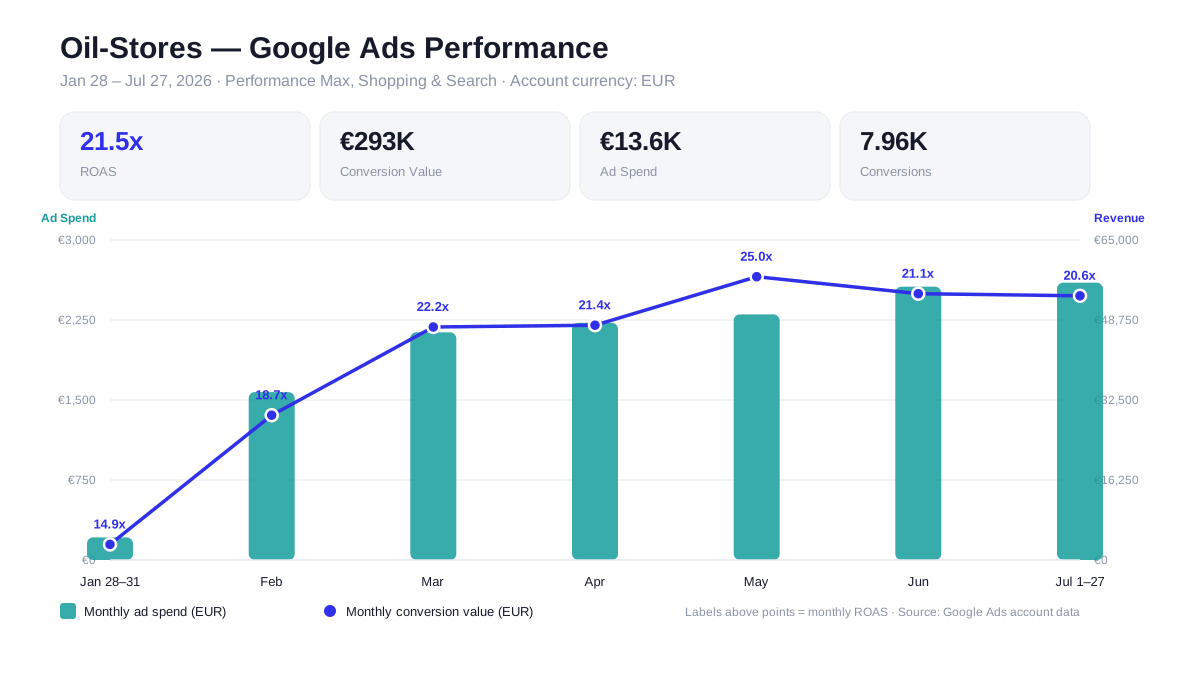
€293K in tracked revenue at 21.5x ROAS across six months
From Jan 28 to Jul 27, monthly ad spend scaled from roughly €212 in the first few days to over €2,600 a month, while ROAS held between 18x and 25x throughout the ramp - peaking at 25.0x in May. The account produced €292,901 in tracked conversion value on €13,608 in spend, with 7,960 conversions at a €1.71 average cost per conversion across 142,004 clicks.
Before Logical Gecko
- ·Six abandoned seasonal campaigns cluttering the account
- ·No dedicated brand campaign to capture high-intent branded search
- ·Feed and campaign structure not aligned to the catalog's real categories
- ·Spend near zero with no scaling plan
- ·No clear read on which category lines were actually profitable
After Logical Gecko
- 21.5x ROAS sustained while monthly spend scaled more than 12x
- €292,901 in tracked conversion value over six months
- 7,960 conversions at a €1.71 average cost per conversion
- Five purpose-built campaigns replacing a fragmented account
- Category-level visibility into which segments of the catalog drive profit
What other brands can take from this
Clean the account before you scale it
Six dead campaigns and a handful of stale tests were quietly distorting reporting. Removing them before adding budget made every optimization decision after that more reliable.
A huge catalog needs category-level structure, not one big campaign
Lubricants, parts, and accessories behave differently by vehicle type. Segmenting Shopping and Performance Max around those categories, not the account as a whole, is what let budget find the winners.
Gradual scaling protects ROAS better than a big jump
Ramping spend month over month, gated on ROAS holding at each tier, avoided the learning-phase resets that would have come from scaling too fast.
Not every segment needs to be a star
Dynamic Search Ads run just under breakeven on a small, deliberately capped budget. Left in place at a small scale, it still surfaces new search terms worth feeding into Brand and Shopping.
Want Results Like This In Your Account?
We will audit your Google Ads account, show you exactly where the budget is leaking, and map out the structure needed to scale profitably. No obligation, no pressure.
More Google Ads Case Studies
Real accounts, real spend, real tracked revenue. See exactly how each result was built.
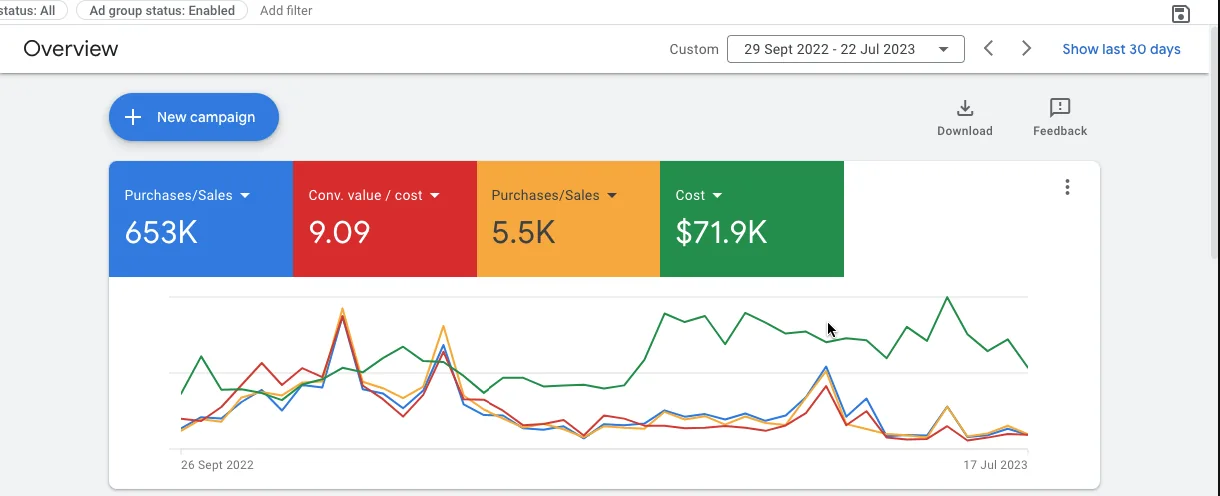
9.09x ROAS and $653K in Tracked Revenue
A full account restructure and bidding overhaul turned inefficient spend into $653,000 in tracked conversion value at a $13.07 cost per conversion.
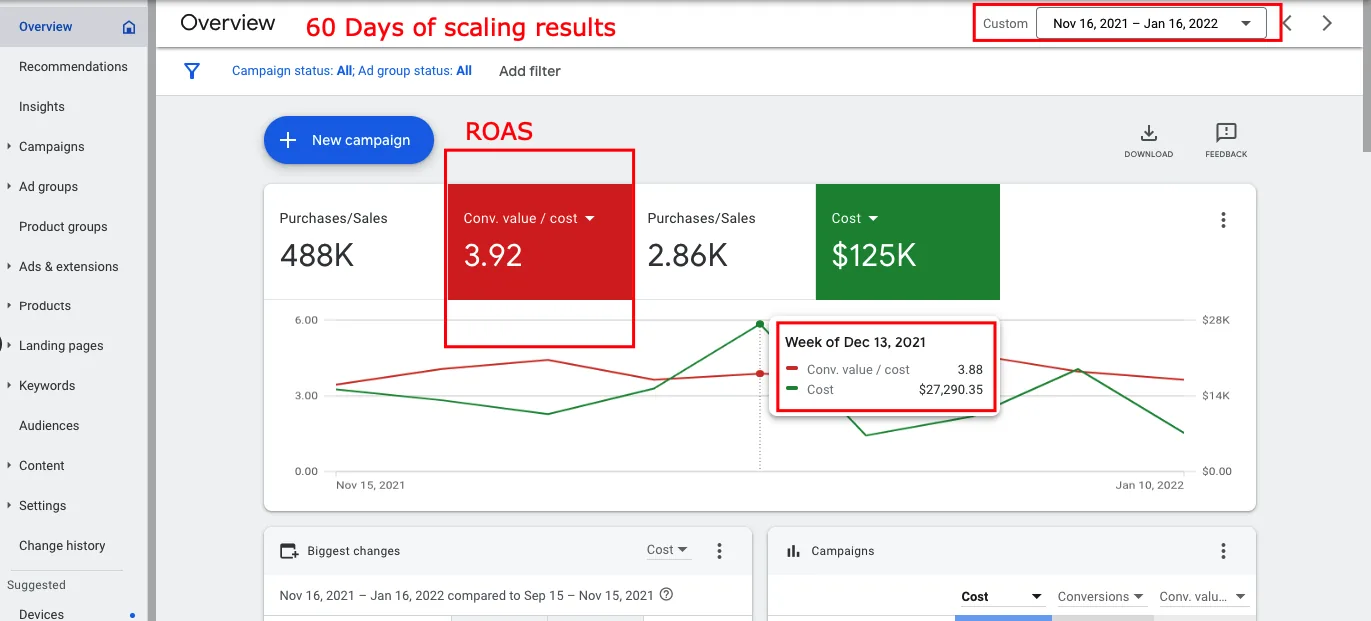
Breaking a $50K/Month Plateau to $488K in 60 Days
Full-funnel restructuring and audience expansion pushed a stalled wall-art brand past its ceiling to $488,000 in tracked revenue at 3.92x ROAS.
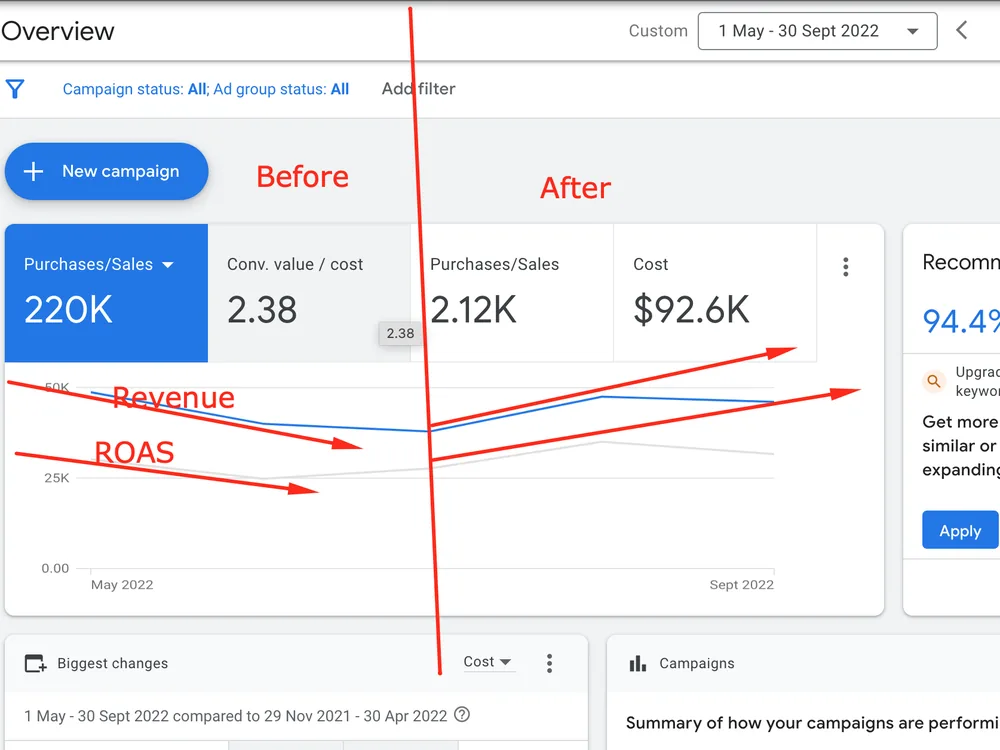
Reviving a Declining Account to $220K in Sales
A declining global haircare account was restructured and stabilized, producing $220,000 in sales at a steady 2.38x ROAS over five months.
8.6x ROAS on High-Ticket Outdoor Products
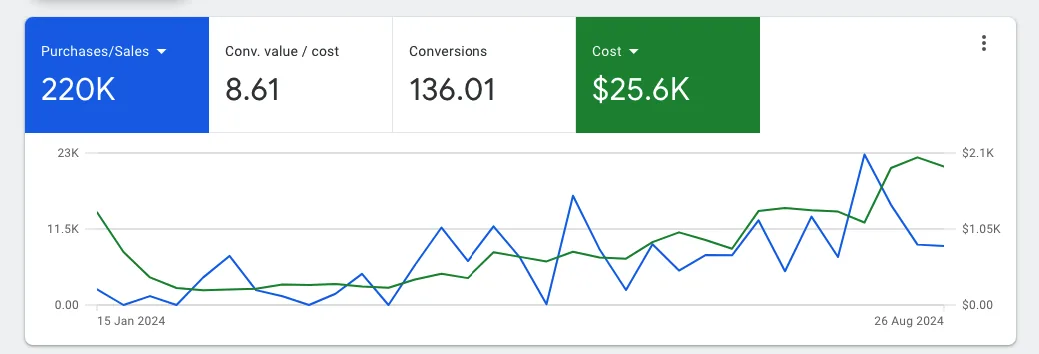
A seasonal, high-ticket outdoor brand scaled to $220,000 in sales at 8.6x ROAS by targeting high-intent buyers instead of chasing volume.
These case studies represent selected examples from our broader Google Ads work. Results vary depending on budget, offer, market competition, tracking setup, and website conversion rate.