Quick answer
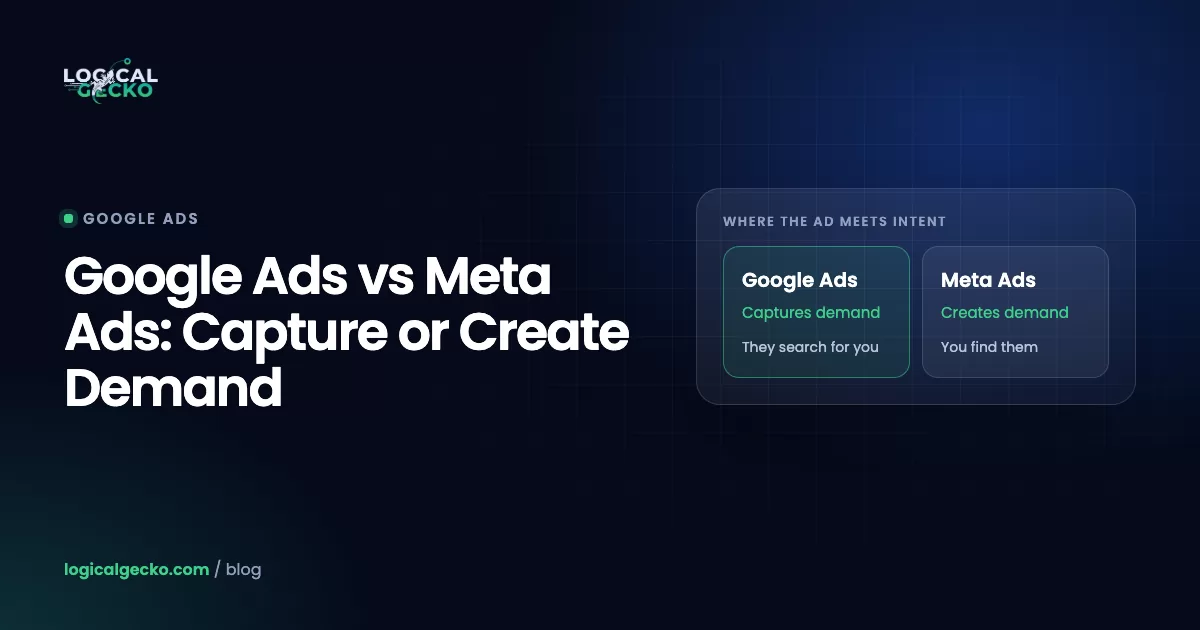
Google Ads is better when people already search for what you sell, because it captures demand from people typing a need into Google right now. Facebook (Meta) Ads is better when they don't, because it creates demand by putting your offer in front of likely people through targeting and creative. Check search volume first, then decide.
Key takeaways
- Google Ads captures existing demand from active searches; Meta Ads creates demand by interrupting people in Facebook and Instagram feeds.
- The deciding test is search volume: if Keyword Planner shows real monthly searches for your product or service in your area, fund Google first.
- Meta usually wins on cost per click and cost per lead, and Google usually wins on intent: LocaliQ's 2026 data puts search CPL at $66.69 and Facebook leads-campaign CPL at $27.39.
- For home services, Local Services Ads and Search catch urgent jobs; Meta works for seasonal offers, slower decisions and retargeting.
- Both platforms claim credit for the same sale, so judge the combined budget on MER from your own store or CRM data, not on the two dashboards.
On this page
- What is the difference between Google Ads and Facebook Ads?
- Google Ads vs Facebook Ads: side-by-side comparison
- Which is better, Google Ads or Facebook Ads?
- Is Facebook Ads cheaper than Google Ads?
- Google Ads vs Facebook Ads for eCommerce
- Google Ads vs Facebook Ads for local and home service businesses
- When is Facebook Ads the better choice?
- How should you split your budget between Google Ads and Meta Ads?
- How do you measure Google Ads and Meta Ads fairly?
- FAQ
What is the difference between Google Ads and Facebook Ads?
Google Ads captures demand that already exists, and Facebook Ads creates demand that doesn't exist yet. On Google, your ad answers a search someone typed a second ago, such as "water heater repair near me" or "cast iron fire pit". On Facebook and Instagram, your ad interrupts someone scrolling a feed who was not looking for you at all.
That one difference drives everything else. Google sells access to intent, so clicks cost more and convert better. Meta sells access to attention, so reach is cheap and the creative has to do the persuading. Meta's ads run across Facebook, Instagram, Messenger and the Audience Network, so "Facebook Ads" and "Meta Ads" mean the same platform.
Google Ads: demand capture
- Triggered by a search query or product data
- Person is already looking for a solution
- Volume capped by how many people search
- Wins on urgent needs and known products
Meta Ads: demand creation
- Triggered by who the person is and how they behave
- Person is browsing, not shopping
- Volume capped by budget and creative, not searches
- Wins on visual, new or impulse products
Google Ads vs Facebook Ads: side-by-side comparison
The table below compares the two platforms on the nine factors that decide where your budget works harder. Read your business into each row rather than counting wins.
| Factor | Google Ads | Facebook (Meta) Ads |
|---|---|---|
| Intent | High. The person searched for it. | Low to medium. The person was scrolling. |
| Targeting | Keywords, product data from Merchant Center, location, audience signals | Demographics, interests, behaviors, custom audiences and lookalikes, with Advantage+ audience expanding past your inputs |
| Ad formats | Text Search ads, Shopping ads, YouTube video, Display, Performance Max across all Google inventory, Local Services Ads | Image, video, Reels, Stories, carousel, collection, Advantage+ catalog ads, instant-form lead ads |
| Typical funnel stage | Bottom: ready to call or buy | Top and middle, plus retargeting at the bottom |
| Creative needs | Low for Search; a clean product feed for Shopping | High: new images and videos every few weeks to fight ad fatigue |
| Cost model | Mostly cost per click; Local Services Ads charge per valid lead | Mostly charged per 1,000 impressions (CPM); some setups allow charging per link click |
| Tracking and attribution | Data-driven attribution, 30-day click-through window by default | 7-day click and 1-day view windows; view-through credit included by default |
| Speed to results | Same week for Search, because the demand is already there | 2 to 6 weeks of creative and audience testing is common |
| Best-fit businesses | Home services, emergency trades, high-ticket searched products, known brands | New product categories, visual and impulse products, lifestyle brands, events and offers |
Sources for the platform rows: Google's conversion window documentation and Meta's attribution settings help page. The speed row reflects our experience running both platforms, not a published benchmark.
Which is better, Google Ads or Facebook Ads?
Google Ads is the better first channel for most businesses whose product or service people already search for, and Meta is the better first channel when search volume is close to zero. The fastest way to know which you are is to check the searches yourself before you spend a dollar.
- List the words people use. Write 10 to 20 phrases a person would type when they need you: "emergency plumber", "ac repair near me", "linen duvet cover king".
- Check volume in Keyword Planner. In Google Ads, open Tools › Planning › Keyword Planner, choose Get search volume and forecasts, paste the list and set the location to your service area or the US.
- Read the result honestly. Hundreds or thousands of monthly searches for buying phrases means demand exists and Google should get your first dollars. Single-digit volumes mean people do not know to look for you yet, and Meta has to create the demand.
- Check the math. Multiply the top-of-page bid range by 10 to 15 to estimate a cost per lead at a 7% to 10% conversion rate. If one job or order cannot carry that cost, Google Search is the wrong starting point.
Is Facebook Ads cheaper than Google Ads?
Facebook Ads is cheaper per click and usually cheaper per lead, but Google Ads is often cheaper per paying job or first order, because the person arrives with intent. The difference comes from how each platform charges.
Google Search runs a keyword auction and charges when someone clicks. You compete with every business bidding on the same query, which is why a "roof replacement" click costs several dollars. Meta mostly charges per 1,000 impressions, according to its help page on getting charged, so your cost per click depends on how many people click the ad you paid to show.
CPM ÷ (CTR × 1,000)Illustrative math with Triple Whale's 2026 Meta benchmarks: a $15.06 CPM and a 2.39% CTR give $15.06 ÷ 23.9 = about $0.63 per click. Double the CTR with better creative and the click cost halves. On Google, better ads lift Quality Score, but the keyword auction sets the floor.
| Benchmark (LocaliQ, 2026 data) | Google Search ads | Facebook ads |
|---|---|---|
| Average cost per click, all industries | $5.42 | $0.60 (traffic campaigns), $1.80 (leads campaigns) |
| Average conversion rate | 8.18% | 8.54% (leads campaigns) |
| Average cost per lead | $66.69 | $27.39 (leads campaigns) |
| Home and Home Improvement CPC | $8.33 | $2.18 (leads campaigns) |
| Home and Home Improvement CPL | $90.92 | $42.95 (leads campaigns) |
Those averages compare different kinds of leads. A Meta instant-form lead is someone who tapped a pre-filled form in their feed. A Google Search lead is someone who searched, read your page and called. In our experience the share of those leads that turn into booked jobs differs a lot, so compare cost per qualified lead, not cost per form.
Illustrative example for a roofing company: Google Search at $8 per click and an 8% conversion rate costs $100 per lead. Meta at $2 per click and a 5% rate costs $40 per lead. If 60% of Google leads book an inspection and 20% of Meta leads do, the cost per booked inspection is $167 on Google and $200 on Meta. Run the same math with your own CRM numbers before you shift budget.
Google Ads vs Facebook Ads for eCommerce
For most eCommerce brands, Google Shopping and Performance Max convert existing product searches more efficiently, and Meta's Advantage+ sales campaigns reach people who were not looking yet. Stores selling searched products lean Google; stores selling new or visual products lean Meta.
| Google: Shopping and Performance Max | Meta: Advantage+ sales campaigns | |
|---|---|---|
| What powers it | Your Merchant Center product feed. Shopping ads use product data, not keywords, to decide when to show. | Your Meta catalog and pixel data, with AI choosing creative, audience, placement and budget. |
| Where ads run | Standard Shopping on Search and the Shopping tab; Performance Max across Search, Shopping, YouTube, Display, Discover, Gmail and Maps | Facebook, Instagram, Messenger and Audience Network placements |
| What triggers the ad | A search for something in your feed | Meta's prediction that a person is likely to buy |
| Retargeting | Remarketing through Performance Max and Display | Advantage+ catalog ads showing the exact products someone viewed |
| Main lever | Feed quality: titles, product types, prices, availability | Creative volume: new videos and images every few weeks |
Meta renamed Advantage+ shopping campaigns to Advantage+ sales campaigns, so older guides use the old name. On Google, you run Shopping ads through either a Standard Shopping campaign or Performance Max with a Merchant Center feed.
Triple Whale's 2026 benchmarks, drawn from tens of thousands of eCommerce brands between August 2025 and July 2026, show the gap in intent:
That caveat matters. Google's reported ROAS includes brand searches, and some of those people first saw you on Instagram. Meta's number is lower partly because it pays for the introduction. A store that cuts Meta because its ROAS looks weaker often watches branded search volume fall a few weeks later.
The Google side of the case is strongest for high-ticket products people research by name. Fire Pit Surplus reached 8.6x ROAS, $220,000 in sales on $25.6K of spend, by putting budget on purchase-ready fire pit searches and excluding research traffic. If your catalog works like that, our eCommerce Google Ads management starts with the feed and Shopping structure before anything else.
Google Ads vs Facebook Ads for local and home service businesses
For plumbers, HVAC companies, roofers and other home services, Google wins the urgent jobs and Meta supports the slower ones. A homeowner with a burst pipe searches Google and calls the first trusted result. Nobody scrolls Instagram hoping to find a plumber.
Google gives local businesses two tools. Local Services Ads appear above regular ads with a Google Guaranteed or Google Screened badge, and you pay per valid lead, not per click. Google's How leads work page lists calls you answer, voicemails, messages and booking requests as valid leads. Search campaigns then cover the services and keywords LSAs miss. Our guide to Google Local Services Ads covers setup and lead disputes.
Meta earns a smaller role for local businesses:
- Seasonal offers. A fall furnace tune-up or spring AC check reaches homeowners before anything breaks.
- Slow, visual decisions. Roof replacements, remodels and landscaping take weeks to decide, and before-and-after photos persuade.
- Retargeting. People who visited your site but did not call see your reviews and guarantee for the next few weeks.
- Service-area awareness. A new location or a new service line needs people to know you exist before they search your name.
The trade-offs by trade are different. Emergency work such as plumbing runs almost entirely on Search and LSAs. Seasonal trades such as HVAC add Meta before peak season to fill the schedule. LocaliQ's 2026 data puts Home and Home Improvement search leads at $90.92 and Facebook leads at $42.95, which is the price gap between a homeowner who needs the job done and one who might.
When is Facebook Ads the better choice?
Facebook Ads is the better choice when there is not enough search demand to buy. That covers more businesses than Google-first agencies admit, including some of the brands we talk to.
- You sell something new that people do not know to search for, such as a new gadget, format or ingredient.
- Your product sells on sight: apparel, jewelry, home decor, beauty, food and gifts.
- Your average order is low and the purchase is an impulse, so a $5 search click cannot pay for itself.
- You can produce new short videos and images every few weeks, or you have creators who can.
- Your best prospects are defined by interests or life stage rather than by a query.
- Search CPCs in your category are so high that the cost per first order breaks your margin.
- You need to retarget people who visited your store and left, with the exact products they viewed.
Meta has limits too. Tracking depends on the Meta pixel and Conversions API, creative wears out fast, and results swing more week to week than Search does. Meta also needs volume to learn: it marks an ad set learning limited when it is unlikely to get about 50 optimization events in a week, so a small budget spread across many ad sets rarely stabilizes.
How should you split your budget between Google Ads and Meta Ads?
Fund Google up to the point where your searches run out or your cost per sale stops clearing your target, then put the rest into Meta. A fixed percentage split ignores the one number that matters: how much search demand exists.
- Find the search ceiling. In live campaigns, add Search impr. share and Search lost IS (budget) under Columns › Modify columns › Competitive metrics. If lost impression share from budget is above 10% and your cost per sale is on target, Google can take more money.
- Fund Google to that ceiling. Raise budgets until lost impression share from budget nears zero or the cost per sale on the extra spend passes your target. Your break-even ROAS sets that target for eCommerce.
- Size Meta to its learning needs. Multiply your target cost per purchase by 50 to get a weekly budget that lets one ad set learn. At a $40 target, that is $2,000 a week.
- Consolidate if the money is short. Below that level, run one Advantage+ sales campaign and one retargeting campaign instead of many small ad sets.
- Rebalance monthly on MER. Move budget toward whichever platform raises total store revenue, not whichever reports the higher ROAS.
Illustrative example: a store with $10,000 a month finds that Search and Shopping reach their impression share ceiling at $6,500 while holding a 4x ROAS. The remaining $3,500 goes to Meta, about $800 a week. At a $40 cost per purchase that is 20 purchases a week, below the 50 Meta wants, so it runs one Advantage+ sales campaign rather than five ad sets.
A home-service business usually ends up heavier on Google, because its search ceiling is high and urgent. A new DTC brand with little search volume usually ends up heavier on Meta until branded searches grow.
How do you measure Google Ads and Meta Ads fairly?
Measure the combined program on your own revenue data, because each platform counts conversions by its own rules and both will claim the same sale. Add the two dashboards together and the total usually exceeds what your store or CRM recorded.
The rules differ in three ways. Google Ads uses data-driven attribution and a 30-day click-through window by default. Meta's standard setting counts a purchase up to 7 days after a click and 1 day after someone merely viewed the ad. A person who sees an Instagram ad, searches your brand on Google two days later and buys is counted as a conversion by both.
Total store revenue ÷ Total ad spend (all platforms)MER, or marketing efficiency ratio, cannot double count, because it uses your actual revenue and your actual spend. Use platform ROAS to steer campaigns day to day, and use MER to decide the budget split. The ROAS formula guide shows how MER and ROAS fit together.
- Fix tracking first. One primary purchase or lead action per platform, the right values, and no duplicates. Our Google Ads conversion tracking guide covers the checks.
- Track first orders separately. Retargeting and brand search look strong because they reach people who were buying anyway.
- Run a holdout test. Pause Meta in a set of states or cities for 3 to 4 weeks and compare revenue with the regions where it kept running. The drop is what Meta really adds.
- For lead gen, close the loop. Import booked jobs from your CRM so both platforms bid toward paying jobs, not form fills.
Muir Way reached $488,000 in tracked revenue in 60 days at 3.92x ROAS while we monitored blended ROAS next to platform ROAS every week, so scaling decisions rested on revenue the store actually banked. If you want a second opinion on your own split, start with a free Google Ads audit: we check tracking, search demand and how much more Google can take before Meta should get the next dollar. For ongoing work, see our Google Ads management services.
Frequently asked questions
Is $20 a day good for Google Ads?
$20 a day is enough for one tightly targeted Search campaign, not a full account. That is about $608 a month. At LocaliQ's 2026 average search CPC of $5.42, it buys roughly 112 clicks, or about 9 leads at the 8.18% average conversion rate. In Home and Home Improvement, where the average CPC is $8.33, the same budget buys about 73 clicks.
Is $500 enough for Facebook ads?
$500 a month is enough to test one offer or run retargeting, not to scale prospecting. Meta flags an ad set as learning limited when it is unlikely to get about 50 optimization events in a week. At LocaliQ's 2026 leads-campaign average of $27.39 per lead, $500 buys about 18 leads a month, well short of that threshold.
How much do Facebook ads cost per 1000 views?
Meta ads cost about $15 per 1,000 impressions for eCommerce brands: Triple Whale's benchmark for August 2025 to July 2026 shows a $15.06 CPM, up 13.24% year over year. Your CPM moves with the season, placement, audience size and objective. Conversion-optimized campaigns and the fourth quarter cost more per 1,000 impressions than broad reach campaigns in quiet months.
Are Google Ads worth it for small businesses?
Google Ads is worth it for a small business when people search for its service in its area and someone answers the phone. Location targeting means a plumber in one county pays only for searches in that county. It is not worth it when monthly search volume is near zero or when the average job value cannot cover a cost per lead of $60 to $100.
What are the disadvantages of using Google Ads?
The main disadvantage of Google Ads is that it cannot grow past existing search demand: once you win most of the searches, more budget buys little. Clicks cost more than on Meta, competitors bid on your brand name, and Performance Max reports less detail than Search. Poor negative keyword lists also waste money on research and job-seeker queries.
Is it worth paying for Facebook ads?
Facebook ads are worth paying for when your product sells on sight, when you are launching something people do not search for yet, or when you need to retarget site visitors. They are a poor first channel for urgent services. Judge them on MER and first-order revenue from your own data, because Meta's view-through credit flatters its reported return.
Sources13 references
- Google Ads Help: About Performance Max campaigns
- Google Ads Help: About Shopping ads
- Google Ads Help: About conversion windows
- Local Services Help: How leads work
- Meta Business Help: About Advantage+ sales campaigns
- Meta Business Help: About Advantage+ catalog ads
- Meta Business Help: About attribution models and attribution settings
- Meta Business Help: About getting charged
- Meta Business Help: About learning limited
- LocaliQ: Search Advertising Benchmarks for Every Industry (2026 data, updated June 1, 2026)
- LocaliQ: Facebook Advertising Benchmarks for 2026 (updated September 23, 2026)
- Triple Whale: Google Ads Benchmarks by Industry (Aug 2025 to Jul 2026 data)
- Triple Whale: Facebook Ad Benchmarks by Industry (Aug 2025 to Jul 2026 data)