Quick answer
A GTIN (Global Trade Item Number) is the 8, 12, 13 or 14 digit number under a product's barcode that identifies that exact product anywhere in the world. In the US it is usually the 12-digit UPC. Only GS1 issues GTINs. Google Merchant Center wants the GTIN for every product that has one, and accepts brand plus MPN, or identifier_exists set to no, for products that don't.
Key takeaways
- GTIN stands for Global Trade Item Number, and it comes in four lengths: GTIN-8, GTIN-12 (the UPC), GTIN-13 (EAN, JAN and ISBN-13) and GTIN-14 for cases and multipacks.
- A UPC is a 12-digit GTIN printed as a UPC-A barcode, so every UPC is a GTIN but not every GTIN is a UPC, while a SKU is an internal code that nobody outside your store recognizes.
- Only GS1 issues real GTINs; as of October 2026, GS1 US licenses a single GTIN for $30 with no renewal fee, or 10 GTINs for $250 plus $50 a year.
- Google Merchant Center wants the manufacturer's GTIN on every product that has one, and products without one (private label, custom, handmade, vintage) use brand plus MPN or identifier_exists set to no.
- Google's product data specification says an incorrect GTIN gets a product disapproved, while its fix pages treat a missing GTIN as a limited performance issue, so a wrong GTIN is worse than a blank field.
On this page
- What is a GTIN?
- What are the types of GTIN?
- GTIN vs UPC vs EAN vs SKU vs MPN: what is the difference?
- How do you get a GTIN for your products?
- Does Google Merchant Center require a GTIN?
- How do you fix GTIN errors in Google Merchant Center?
- Where do you add a GTIN in Shopify, WooCommerce or a product feed?
- How do GTINs help Shopping ads reach the right searches?
- What does a clean GTIN setup look like for a small store?
- FAQ
What is a GTIN?
A GTIN is the number printed under a product's barcode. It identifies one exact product, in one size and one color, everywhere in the world. GTIN stands for Global Trade Item Number, and GS1, the global standards body behind barcodes, is the only organization that issues them.
The GTIN is the number. The barcode is the black and white bars that let a scanner read it. GS1 US explains that a GTIN has two jobs. In a physical store, the barcode is scanned at checkout. Online, the GTIN makes sure the item you list is the item that gets picked, packed and shipped. Marketplaces and Google also use it as a key to pull up everything else they know about that product.
Because the brand owner assigns the GTIN, every store that sells the same product submits the same number. That is what makes it useful to Google: when 40 stores sell the same blender, the shared GTIN tells Google it is one product with 40 offers, not 40 different blenders.
What are the types of GTIN?
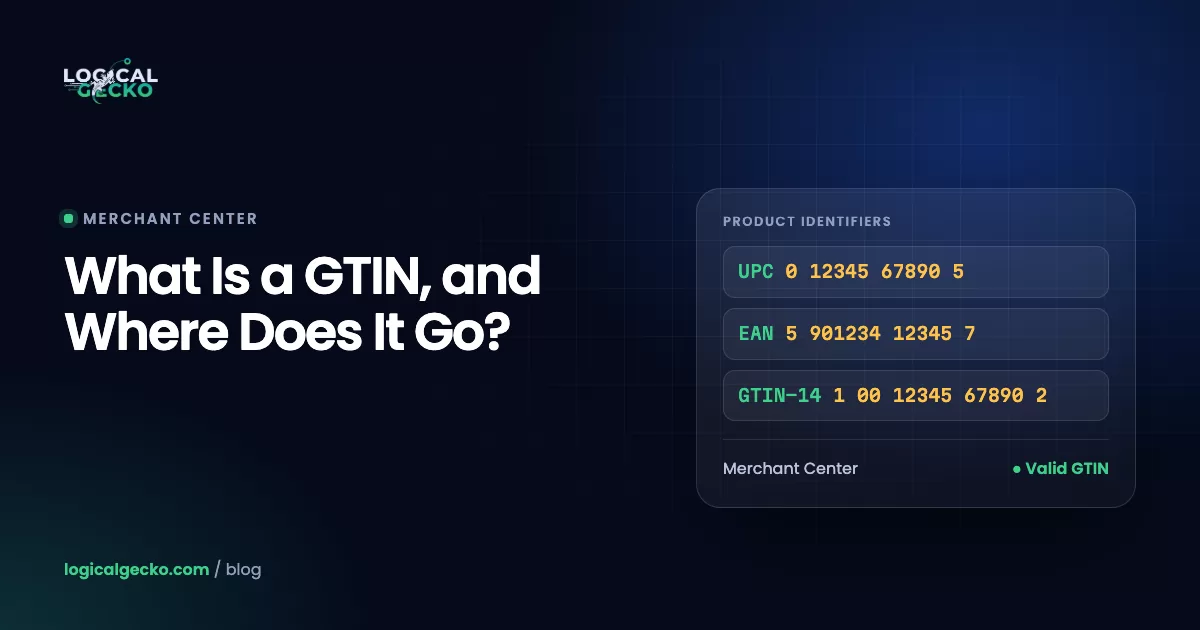
There are four GTIN lengths: GTIN-8, GTIN-12, GTIN-13 and GTIN-14. Most US products carry a GTIN-12, better known as the UPC. Products made for Europe and most other countries carry a GTIN-13, called an EAN. Books use a 13-digit ISBN, which is also a GTIN-13.
| Type | Digits | Also called | Barcode it fits | Typical use | Merchant Center note |
|---|---|---|---|---|---|
| GTIN-12 | 12 | UPC, UPC-A | UPC-A | Most retail products in the US and Canada | Convert 8-digit UPC-E codes to 12 digits |
| GTIN-13 | 13 | EAN, EAN-13; JAN in Japan | EAN-13 | Products sold outside North America | JAN can be 8 or 13 digits |
| ISBN-13 | 13 | ISBN | Barcode on the back cover | Books; starts with 978 or 979 | Convert ISBN-10 to ISBN-13 |
| GTIN-8 | 8 | EAN-8 | EAN-8 | Very small items with little label space | Submit as is |
| GTIN-14 | 14 | Case code, ITF-14 | ITF-14 or GS1-128, never UPC or EAN | Cases, cartons and multipacks | Only for packs you sell as one item; indicator 9 is rejected |
The type rows and digit counts come from GS1 US and GS1 Support; the Merchant Center notes come from Google's gtin attribute page.
How is a GTIN built?
Every GTIN has three parts: a GS1 Company Prefix licensed to the brand, an item reference the brand picks for each product, and a check digit at the end. A GTIN-14 adds an indicator digit at the front. Digits 1 to 8 mark a packaging level, such as a case of 12, and 9 marks a variable measure item, per the GS1 US GTIN guideline.
The check digit catches typos. If one digit is wrong or two digits are swapped, the math no longer adds up, and Merchant Center flags the value as invalid.
Next multiple of 10 minus (digits × 3, 1, 3, 1, counted from the right)Here is GS1's method applied to the sample GTIN-13 that Google uses in its own help pages, 3234567890126:
- Take every digit except the last. 3 2 3 4 5 6 7 8 9 0 1 2.
- Multiply from the right by 3, then 1, then 3, and so on. Left to right that gives 3, 6, 3, 12, 5, 18, 7, 24, 9, 0, 1, 6.
- Add the results. The sum is 94.
- Subtract from the next multiple of ten. 100 minus 94 is 6, which matches the last digit of 3234567890126.
You rarely need to do this by hand. GS1 has a free check digit calculator. The point is simpler: a number that fails this test is not a GTIN, and a number that passes it can still belong to someone else.
GTIN vs UPC vs EAN vs SKU vs MPN: what is the difference?
GTIN is the umbrella name. A UPC is a 12-digit GTIN and an EAN is a 13-digit GTIN, so both are GTINs. A SKU is your own stock code, and an MPN is the manufacturer's part number. Neither a SKU nor an MPN is a GTIN.
| Identifier | What it is | Who assigns it | Unique worldwide? | Merchant Center field |
|---|---|---|---|---|
| GTIN | The global product number in any of the four lengths | The brand owner, from a GS1 license | Yes | gtin |
| UPC | A GTIN-12 and the UPC-A barcode that carries it | The brand owner, through GS1 US | Yes | gtin |
| EAN | A GTIN-13 and the EAN-13 barcode that carries it | The brand owner, through a GS1 office | Yes | gtin |
| MPN | The manufacturer part number or model number | The manufacturer | Only within that brand | mpn, 1 to 70 characters |
| SKU | An internal stock code for your inventory | You | No; only inside your store | Google suggests it for id |
| Brand | The maker's brand name on the packaging | The manufacturer | No | brand, 1 to 70 characters |
One mix-up is easy to make: an internal SKU in the gtin field. Google's unique product identifier guidance says not to put internal SKUs or other store-specific values in gtin, brand or mpn. Ten stores selling the same product share one GTIN, but each has its own SKU.
GTIN (global)
- Issued through GS1 to the brand owner
- Same number at every store that sells the product
- Printed under the barcode
- Lets Google match your offer to the product
SKU (internal)
- Made up by you
- Different at every store
- Lives in your inventory system
- Belongs in id, never in gtin
JAN codes follow the same logic: a JAN is the Japanese name for a GTIN-13 (or GTIN-8), so it goes in the gtin field too.
How do you get a GTIN for your products?
If you resell another company's products, you don't buy GTINs. You copy the manufacturer's number from the packaging or ask the supplier. If you own the brand, you license GTINs from GS1, which is the only legitimate source. GS1 Support states that only GS1 can provide a GS1 GTIN and that you get one by joining your local GS1 Member Organization, which in the US is GS1 US.
- Count your variants. Every size, color, scent and pack size is its own product. GS1 US uses the example of a t-shirt in 3 sizes and 3 colors: 9 products, so 9 GTINs.
- Pick a license. A single GS1 US GTIN suits a few products. A GS1 Company Prefix suits a growing line, because it covers a block of numbers.
- Check out on the GS1 US store. GS1 US says a welcome email arrives within minutes, and both options include its Data Hub tool.
- Assign and print. Use Data Hub to assign each GTIN to a product and create the barcode artwork.
- Add the numbers to your store and feed. Put each GTIN on the matching variant, as shown in the platform section below.
As of October 2026, GS1 US lists these prices on its barcode pricing page. GS1 US can change them at any time.
| GS1 US option | GTINs included | Initial fee | Annual renewal |
|---|---|---|---|
| GS1 US GTIN (single) | 1 | $30 | $0 |
| GS1 Company Prefix | 10 | $250 | $50 |
| GS1 Company Prefix | 100 | $750 | $150 |
| GS1 Company Prefix | 1,000 | $2,500 | $500 |
| GS1 Company Prefix | 10,000 | $6,500 | $1,300 |
Single GTINs can't be used for pharmaceutical products, variable measure items, mixed cases or coupons. For those you need a prefix.
Why cheap resold barcodes fail
Barcode resellers sell numbers that GS1 first licensed to some other company. GS1 states that it never issues the same GTIN twice and does not allow GTINs to be transferred or resold. On its selling online page, GS1 explains that a resold number shows up in its public database with the data of the company that first licensed it, not yours.
That causes two problems. If the number was ever used on another product, Google sees a GTIN that belongs to something else and flags it as an Incorrect GTIN, which leads to disapproval. And anyone can look the number up in the GS1 Company Database, where it points to a company that isn't you. Amazon goes further: GS1 US quotes Seller Central saying Amazon checks UPCs against the GS1 database and treats non-matching ones as invalid.
Don't fix a missing GTIN by buying one for a product you didn't make. A GTIN belongs to the brand owner. If you resell someone else's product, use their GTIN or leave the field blank. Licensing a new number for another brand's product creates exactly the mismatch Google's Incorrect GTIN issue is built to catch.
Does Google Merchant Center require a GTIN?
Yes, for any product that has a GTIN assigned by its manufacturer. Google calls the gtin attribute strongly recommended, and says products sent without an identifier they have may get limited performance or be disapproved. Products that never had a GTIN don't need one. For those, you send brand plus MPN, or set identifier_exists to no.
What Google won't accept is a guess. Its product data specification says a product with an incorrect GTIN will be disapproved, and its gtin page says "When in doubt don't provide a GTIN." So when you are unsure, blank beats wrong.
| Your product | gtin | brand | mpn | identifier_exists |
|---|---|---|---|---|
| Branded product you resell (Nike, KitchenAid) | Manufacturer's UPC or EAN | Maker's brand | Maker's part number, if known | Leave out |
| Your own brand with GS1 GTINs | Your GTIN | Your brand | Optional | Leave out |
| Private label or store brand with no GTIN | Blank | Your brand | A unique code of your choice, such as your SKU | Leave out |
| Custom-made or handmade item | Blank | Your store name | Optional | no |
| Vintage, antique or a book from before 1970 | Original GTIN if it has one, else blank | Original brand if known | If known | no, when there is no identifier |
| Bundle you put together | GTIN of the main product | Brand of the main product | MPN of the main product | Leave out |
| Multipack you put together | GTIN of the single item | Brand of the single item | MPN of the single item | Leave out |
The table follows Google's pages on unique product identifiers, MPN and identifier_exists. A few details matter. Used and vintage goods should keep their original GTIN when it exists, with condition set to used. A product you customize, such as an engraved watch, keeps the manufacturer's GTIN. Google also lists replacement parts, OEM parts and pre-order products as items that may lack a GTIN.
When should you set identifier_exists to no?
Set it to no only for new products that have no manufacturer-assigned identifiers: custom goods, handmade items, art, vintage pieces and books published before 1970. The value must be in English (no or false). If you set no and Google finds evidence that the product does have an identifier, the product gets a warning. Don't use it as a shortcut on branded goods with a missing barcode.
Want the bigger picture of how product data moves through Google? Our explainer on what Google Merchant Center is covers feeds, free listings and the Google Ads link.
How do you fix GTIN errors in Google Merchant Center?
Open Products › Needs attention, filter by the issue name, fix the gtin value at the source, and wait for the next sync. Google says fixes can take 24 to 72 hours to clear from the Needs attention list. Each issue below has its own cause, so match the name first.
| Issue in Merchant Center | What it means | How to fix it |
|---|---|---|
| Incorrect GTIN | The GTIN is valid but belongs to a different product, often one reused from another listing | Copy the GTIN from this exact product's packaging or the manufacturer; check that title, image and description match the same product |
| Invalid value [gtin] | Wrong length, letters in the value, or a failed check digit | Send 8, 12, 13 or 14 digits only; recheck the check digit; spaces and dashes are ignored |
| Restricted GTIN | The value starts with 2, 02 or 04, a range Google says is reserved for future use | Replace it with the manufacturer's GTIN, or leave gtin blank if the product has none |
| Unsupported GTIN | A coupon number (starting 981 to 984, 99 or 05) or a GTIN-14 with the bulk indicator 9 | Submit the GTIN of the single sellable item; use GTIN-14 indicators 1 to 8 only for packs you sell as one item |
| Duplicate GTIN | Two products share the same GTIN, multipack and condition values | Give each variant its own GTIN, group variants with item_group_id, and remove listings that appear twice |
| Limited performance due to missing value: GTIN [gtin] | Google expects a GTIN in this category, but you sent none | Add the manufacturer's GTIN; if the product truly has none, make sure brand and MPN are filled |
| Limited performance due to missing identifiers (Google's fix page now calls it Missing or incorrect GTIN) | No usable GTIN, MPN or brand on the product | Send a correct GTIN, or both brand and MPN; for custom or vintage items, set identifier_exists to no |
Limited performance issues don't stop a product from showing, but Google says such products may get limited visibility. Incorrect and invalid values are more serious, because the product data specification ties incorrect GTINs to disapproval.
To fix many products at once, use the download icon on the Needs attention tab to export a CSV of every affected item. Correct the values where the data comes from, which is your store or your feed file. If you edit a product in Merchant Center while Shopify or WooCommerce syncs it, the next sync can bring the old value back.
Feed rules have a new name. Google renamed feed rules to attribute rules, and they need the Advanced data source management add-on in Merchant Center. You can use them to fill identifier_exists or brand across a whole category, but fix wrong GTINs at the source so the same bad number doesn't come back on the next sync.
Shopify warns that incorrect identifiers can stop products from publishing and can put the account at risk of suspension. If GTIN problems sit alongside a suspension notice, our Merchant Center suspension recovery team can check whether the identifiers are part of the cause.
Where do you add a GTIN in Shopify, WooCommerce or a product feed?
Each platform keeps the GTIN on the variant, because each size and color has its own number. Add it once in your store, and the Google connector sends it to Merchant Center as the gtin attribute.
Shopify
- Open the product, then the variant, and find Barcodes in the Inventory section. Per Shopify's product details guide, each barcode has a type: Custom, GTIN, UPC, EAN, ISBN or ASIN. Choose the type that matches the number instead of leaving it on Custom.
- Shopify's Google & YouTube channel requirements say a product that has a GTIN needs it before it can publish. For products without one, add MPN and brand in the Google & YouTube channel.
- Don't type the SKU into the barcode field to make a warning go away. That trades a limited performance issue for a disapproval.
WooCommerce
- Since WooCommerce 9.2 (August 2024), the Inventory tab has a field labeled GTIN, UPC, EAN or ISBN, on both products and variations. WooCommerce checks that each value is unique across the store.
- The Google for WooCommerce extension also has a Google for WooCommerce tab in Product data where you set GTIN, MPN and brand per product, plus an attribute mapping tool for whole categories.
- For custom or handmade products, WooCommerce's Google for WooCommerce error guide suggests leaving GTIN blank and using the SKU as MPN.
A product feed file
In a CSV or TSV feed, add columns named gtin, brand, mpn and, where needed, identifier_exists. In XML, use <g:gtin>3234567890126</g:gtin> and <g:identifier_exists>no</g:identifier_exists>. Google accepts up to 10 GTIN values per product, which helps when a product carries both a UPC and an ISBN.
If you send products through an API, note that Google sunset the Content API for Shopping on August 18, 2026. Integrations now use the Merchant API, where identifier_exists takes true or false. Our step-by-step guide to Google Merchant Center setup covers connecting each platform for the first time.
How do GTINs help Shopping ads reach the right searches?
Shopping ads have no keywords. Google decides which searches your product can show for by reading your product data, and the GTIN is the most exact part of it. Google says unique product identifiers help match search queries with your products, and that accurate matching can't be assured when the GTIN is missing.
A correct GTIN does three things for your ads and free listings:
- Makes the listing easier to find. Google says a GTIN helps make your ad or free listing easier to find, because it tells Google exactly which product you sell.
- Links your offer to the same product at other stores. The same product carries the same GTIN at every retailer, which is how Google knows your offer and a competitor's are one item.
- Opens price benchmarks. Merchant Center's Analytics › Pricing tab only shows benchmark prices for products with a valid GTIN, since benchmarks come from every retailer selling the same GTIN.
Google has put a number on it before. In a January 2017 post on the Google Ads blog, it said merchants who added correct GTINs saw conversion rates increase up to 20%. That figure is old, but the direction still matches Google's current help pages, which say products with an assigned GTIN submitted without one may have limited visibility.
GTINs feed Performance Max product ads the same way, because those campaigns read the same Merchant Center data. For how product data turns into bids and placements, see our guides to Google Shopping ads and Performance Max campaigns.
What does a clean GTIN setup look like for a small store?
A clean setup gives each product the identifier it really has and nothing it doesn't. Here is an illustrative example, not a client result: a US home goods store with 60 products in three groups.
| Product group | Count | What the store submits | Why |
|---|---|---|---|
| Branded diffusers it resells | 30 | Manufacturer's UPC from each box, maker's brand, maker's MPN | The products already have GTINs, so leaving them out limits visibility |
| Own-label candles: 3 scents × 3 sizes × 2 wax types | 18 | Option A: 18 GS1 US GTINs. Option B: no GTIN, store brand plus SKU as MPN | A store brand without GTINs is allowed; GTINs help if the line will also sell on Amazon or in shops |
| Hand-poured candles with a custom name | 12 | Blank gtin, store name as brand, identifier_exists no | Custom-made goods have no assigned identifiers |
For the 18 own-label candles, the GS1 US price list sets the trade-off. Eighteen single GTINs cost 18 × $30 = $540 once, with no renewal. A 10-GTIN prefix is too small. A 100-GTIN prefix costs $750 up front and $150 a year, but leaves 82 numbers for new scents. If the line will stay small, single GTINs cost less. If the store plans to add a few dozen products, the prefix pays for itself sooner.
Before you upload, run this check on the whole catalog:
- No SKU, order number or made-up value sits in the gtin field
- Every size and color has its own GTIN, with variants grouped by item_group_id
- No GTIN starts with 2, 02, 04, 05, 98 or 99
- Products without a GTIN carry brand plus MPN, or identifier_exists set to no
- The brand matches the name printed on the product
If your catalog is large, or the Needs attention tab is full of identifier issues you can't trace, our Merchant Center management service cleans up product data at the source so fixes survive the next sync.
Frequently asked questions
Is a GTIN the same as a UPC?
A UPC is one kind of GTIN. In the US, the 12-digit number under a UPC-A barcode is a GTIN-12, so every UPC is a GTIN. The reverse is not true: an EAN (13 digits), a GTIN-8 or a GTIN-14 case code is a GTIN but not a UPC. GS1 US puts it simply: the GTIN is the number, and the UPC is the barcode that lets a scanner read it.
How do you convert a GTIN to a UPC?
If a 14-digit GTIN starts with two zeros, drop them and the remaining 12 digits are the UPC. GS1 stores GTINs in a 14-digit field padded with zeros on the left, so 00614141000012 is the UPC 614141000012. A 14-digit GTIN whose first digit is 1 to 8 identifies a case or pack, not a single unit, so it has no UPC version. For single items, the 12-digit UPC is the cleanest value to send to Merchant Center.
Can I make up my own GTIN number?
No. A GTIN only works when it is built from a GS1 Company Prefix licensed to your company, because that prefix is what links the number to your brand in GS1's database. A made-up number may pass the check digit test and still belong to another company's product. Google tells stores never to guess or invent GTINs, and an incorrect GTIN gets the product disapproved. If you can't buy one, leave the field blank and use brand plus MPN.
Is there a GTIN exemption for Google Shopping?
Not as a request. Amazon lets some sellers apply for a GTIN exemption, but Google handles it in your product data instead: leave gtin blank and send brand plus MPN, or set identifier_exists to no for custom, handmade and vintage items. Google may warn you if it finds evidence that a product marked no does have an identifier, so only use it on goods that truly lack one.
Do I need a different GTIN for each size and color?
Yes. Each variation you sell needs its own GTIN, and Google asks for a unique GTIN on every variant, with the item_group_id attribute tying the variants together. GS1 US gives the math: a t-shirt in 3 sizes and 3 colors is 9 products, so it needs 9 GTINs. Reusing one GTIN across sizes or colors triggers a Duplicate GTIN issue in Merchant Center.
Is a GTIN always 14 digits?
No. GTINs come in 8, 12, 13 and 14 digit lengths. Databases often store them in a 14-digit field with leading zeros, which is why some tools show a 12-digit UPC as 00 plus the UPC. GS1 says a padded GTIN-12 stays a GTIN-12. A true GTIN-14 starts with a digit from 1 to 9 and marks a case, a pack level or a variable measure item.
Does a GTIN expire?
A single GS1 US GTIN does not: it has no annual renewal fee as of October 2026. Numbers built from a GS1 Company Prefix are different. If you stop paying the yearly renewal, GS1 US terminates the prefix, you lose the right to use those UPCs, and your company drops out of the GS1 Company Database, so retailers and marketplaces can no longer verify your numbers.
Sources31 references
- Google Merchant Center Help: GTIN [gtin]
- Google Merchant Center Help: About unique product identifiers
- Google Merchant Center Help: Identifier exists [identifier_exists]
- Google Merchant Center Help: MPN [mpn]
- Google Merchant Center Help: Brand [brand]
- Google Merchant Center Help: Find a GTIN
- Google Merchant Center Help: Product data specification
- Google Merchant Center Help: How to fix: Incorrect GTIN
- Google Merchant Center Help: How to fix: Invalid value [gtin]
- Google Merchant Center Help: How to fix: Restricted GTIN
- Google Merchant Center Help: How to fix: Unsupported GTIN (coupon ranges)
- Google Merchant Center Help: How to fix: Unsupported GTIN (bulk indicator 9)
- Google Merchant Center Help: How to fix: Duplicate GTIN
- Google Merchant Center Help: How to fix: Limited performance due to missing value: GTIN [gtin]
- Google Merchant Center Help: How to fix: Missing or incorrect GTIN
- Google Merchant Center Help: About Pricing in Merchant Center Analytics
- Google Merchant Center Help: Set up your attribute rules
- Google Ads Blog: Four resolutions for Shopping success in 2017
- Google for Developers: Content API for Shopping release notes (sunset August 18, 2026)
- GS1 US: What is a GTIN?
- GS1 US: Get your U.P.C. barcodes from GS1 US (pricing)
- GS1 US: GS1 Company Prefix, barcodes and identification FAQs
- GS1 US: An Introduction to the Global Trade Item Number (GTIN), Release 2.1
- GS1: Get your GTIN for selling online
- GS1: How to calculate a check digit manually
- GS1 Support: What is the difference between a GS1 GTIN, a barcode, an EAN and a UPC?
- GS1 Support: How do I get / buy a GS1 GTIN (barcode)?
- Shopify Help Center: Google & YouTube channel requirements
- Shopify Help Center: Product details page (barcodes)
- WooCommerce Developer Blog: WooCommerce 9.2 release (global unique ID field)
- WooCommerce Docs: How to resolve common Google for WooCommerce errors

Safeer leads strategy at Logical Gecko, a Google Partner and Shopify Partner agency that runs Google Ads for eCommerce and home-service brands and recovers suspended Merchant Center accounts. Everything in these guides comes from work on live client accounts. More about the team.